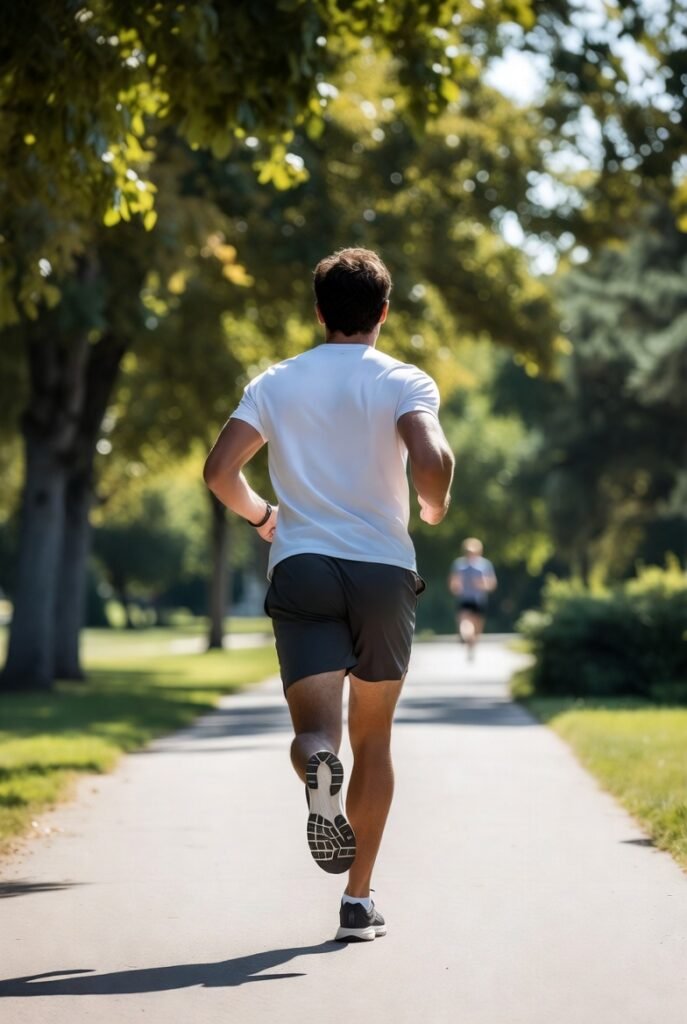
For many, running is more than just a workout; it is a source of joy, a social lifeline, and a vital part of one’s identity. When a medical professional delivers the “stop running” verdict due to early-stage osteoarthritis, the weight of that sentence is crushing—it feels as if your world is collapsing. The outdated medical dogma that once sidelined millions suggests that the only way to save your joints is to hang up your shoes forever and retreat to the pool.
However, this “death sentence” for your passion is frequently based on a persistent myth. Modern sports medicine is revealing a more hopeful truth: you don’t need to quit; you need to “re-tune your engine.” Consider the Sponge Analogy. Your joint cartilage is not like a car tire that simply wears down with use; it is a living tissue that behaves like a sponge. It requires the rhythmic compression and release of movement to circulate joint fluid, which delivers essential nutrients to the cartilage. Without this mechanical stimulus, the “sponge” dries out, losing its resilience and health.
The Counter-Intuitive Truth: Recreational Running Protects Your Knees
The notion that every mile brings you closer to a knee replacement is scientifically obsolete. Landmark research by Lo et al. and Alentorn-Geli et al. confirms that recreational running does not increase the risk of osteoarthritis—in fact, it is significantly more beneficial than a sedentary lifestyle. The key lies in the “dose” of activity.
The medical evidence draws a sharp line between different levels of intensity:
“Recreational runners have a significantly lower risk of knee osteoarthritis (3.5%) compared to sedentary individuals (10.2%). However, professional or competitive runners who train at extremely high volumes face a higher risk (13.3%).”
For the aging athlete, this is a total game-changer. It proves that moderate running provides the biological “signal” your knees need to stay robust. By staying active, you are effectively “oiling the gears” of your joints rather than grinding them down.
The “15% Rule”—Why Stride Length Beats Shoe Tech
Most knee pain in runners stems from “overstriding”—the habit of taking long, reaching steps and slamming the heel into the ground. While the footwear industry wants you to buy your way out of pain, the most potent solution is free: adjusting your Cadence.
By shortening your stride and increasing your step frequency, you ensure your feet land directly under your center of gravity. This simple technical shift reduces the impact on the knee joint by 15–20% immediately. There is a profound irony here: a conscious, no-cost adjustment to your running form is scientifically superior to spending $300 on the latest high-tech “super shoes.”
Build Your Own “Anatomical Shock Absorbers”
To run long into your senior years, you must recognize that running alone isn’t enough to sustain joint health. You must build your own “armor” through dedicated strength training. While technique reduces the load, strength increases your capacity to handle it. You need functional muscles to act as your body’s “natural shock absorbers,” sparing your bones and cartilage from the brunt of the impact.
Specifically, you must target two powerhouse muscle groups:
• Quadriceps: These are the primary stabilizers of the knee joint.
• Glutes: Strong gluteal muscles manage the alignment of the entire lower body, ensuring the load is distributed evenly.
A disciplined 2-3 day split of strength training alongside your runs creates a “chassis” that can handle the road. Furthermore, proactive post-run care—applying cold compresses to the knees—is essential to quiet any minor inflammation and keep the joints “calm.”
The 24-Hour Reality Check and the Traffic Light System
Running with osteoarthritis requires you to be your own coach and diagnostic expert. Before you even lace up, check your “Traffic Light” status:
• Green Light: Early-to-mid stage OA, no current swelling, and sufficient muscle strength. You are cleared to run.
• Red Light: If you have acute swelling (heat/redness), pain with every walking step, severe “bone-on-bone” contact, or significant limb bowing, you must rest and consult a specialist.
If you are in the “Green,” use the 24-Hour Rule to gauge your intensity.
• Passed: If you feel soreness after a run but are pain-free by the next morning, your joint handled the load perfectly.
• Failed: If you wake up to persistent throbbing, swelling, or stiffness that lasts more than 24 hours, you have exceeded your limit. This isn’t a signal to quit—it’s a signal to reduce your distance or speed until you find your body’s “sweet spot.”
The “Max Cushion” Trap
While cushioning can be a tool, more is not always better. The “Max Cushion” trend of ultra-thick, soft soles can be deceptive. If a shoe is too soft, it creates a “marshmallow” effect, causing instability that forces your muscles and joints to work harder to stay balanced.
• Stability Matters: If you have flat feet or bowed legs, look for stability shoes with overpronation support to help align the forces passing through your knee.
• Avoid “Racing Flats” and Carbon Plates: These are designed for pure speed, not joint preservation. Carbon plates are notoriously stiff and “harsh”; the rapid energy return (the “snap”) can be too aggressive for osteoarthritic joints, forcing the knee to absorb forces it can no longer handle.
Conclusion: Run Smarter, Not Less
Managing knee pain doesn’t mean the end of your running career; it marks the beginning of your “evolution.” To protect your longevity, remember that concrete is the enemy. Whenever possible, seek out softer surfaces like rubber tracks, grass, or even a high-quality treadmill. Incorporate Cross-Training (swimming or cycling) 2-3 days a week to provide a non-impact aerobic stimulus while your cartilage recovers.
By adopting this “New Way”—shorter strides, stronger legs, and smarter surfaces—you can keep moving for a lifetime.
Instead of asking, “Can I still run?” the real question is: “Am I willing to evolve my technique to keep my body in motion?”
——————————————————————————–
Disclaimer: This article provides general health information only. If your symptoms persist or if you have specific concerns regarding joint health, consult a specialist such as Dr. Thaninnit Leerapun (Doctor Keng) for a professional evaluation.


Leave a Reply