⏱️ The Biology of the Body Clock Through the Lens of Systems Thinking
Circadian biology is not just a topic about sleep.
It is a system — complete in itself.
If you look at it superficially as “blue light is the villain, morning sunlight is the hero,” you miss the real leverage points that determine your health.
The circadian system is a multi-layered, feedback-controlled network.
It uses environmental cycles to coordinate metabolism, hormones, immunity, mood, repair processes, and performance.
The outcomes you want — better sleep, steady energy, fat loss, sexual performance, resilience — are not isolated targets.
They are emergent properties of that network working in synchrony.
🌐 The Circadian System: What You Actually Need to Manage
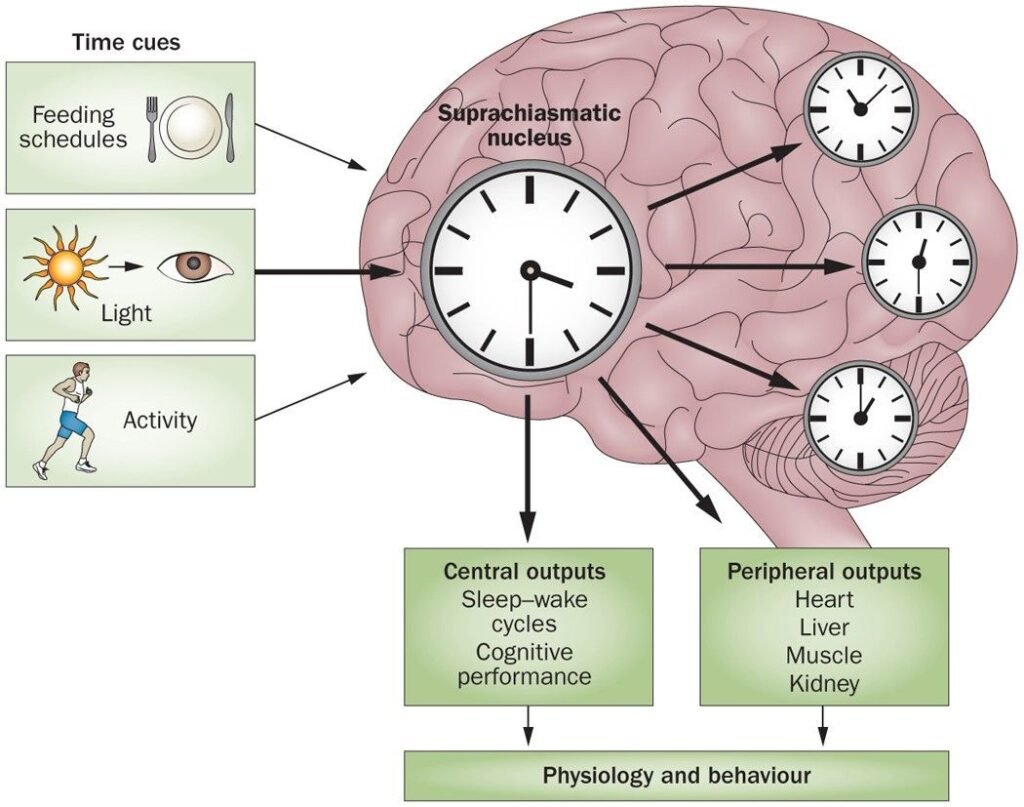
1️⃣ The Central Clock
Located in the brain’s suprachiasmatic nucleus (SCN).
It synchronizes time primarily through light entering the eyes.
2️⃣ Peripheral Clocks
Found in almost every tissue — liver, muscle, fat, gut, skin, immune cells.
These tissues do not simply obey the brain.
They also receive direct time cues from:
-
Meal timing
-
Temperature cycles
-
Physical activity
-
Stress hormones
-
Social schedules
When these signals align → you get high circadian amplitude:
A strong, stable biological rhythm.
When these signals conflict → you develop internal jet lag.
The brain thinks it’s one time.
The liver thinks it’s another.
The immune system behaves as if under chronic threat.
📥 Inputs: The Time-Setting Signals (Zeitgebers)
• Light
The master synchronizer of the brain — determined by intensity, spectrum, direction, and timing.
• Food Timing
The primary synchronizer of the liver and gut.
Eating at the wrong time can shift peripheral clocks — even if your light exposure is perfect.
• Temperature
The body senses time through natural cooling at night and warming during the day.
• Movement
Signals to muscle and metabolism that it is daytime.
• Stress
Cortisol and adrenaline function as “emergency override” signals that can instantly shift biological timing.
📌 Systems Thinking Does Not Optimize One Variable at the Expense of Another
Morning sunlight cannot rescue you
if you still eat late, train late, and flood yourself with blue light at midnight.
Health is not linear.
It is relational.
🔄 Core Dynamics: Feedback Loops
The circadian system runs on interconnected loops:
Morning full-spectrum light →
Advances the clock →
Determines melatonin timing →
Improves sleep depth →
Enhances insulin sensitivity →
Regulates hunger timing →
Feeds back into peripheral clocks.
This is why small habits cascade.
The system is non-linear.
Accumulate enough poor signals and the system shifts into a new stable state — a maladaptive attractor.
You begin to believe:
“I’m just a night owl.”
“I’m naturally anxious.”
When in reality, the system is simply locked into a dysfunctional rhythm.
🤮 Bottlenecks: Where the System Breaks
• Weak daytime signal
Living indoors under dim light → the brain never receives a strong “daytime” cue → nighttime hormones weaken.
• Artificial light at night
Screens and LEDs delay melatonin → fragment sleep.
• Eating after sunset
Forces the liver into the wrong phase → elevates nighttime glucose → disrupts deep sleep.
• Chronic stress
Distorts cortisol rhythms → the body remains in “fight or flight” instead of “repair and restore.”
⏱️ The Ideal Circadian Health Profile
1️⃣ High Amplitude
Clear contrast between day (alert, warm, insulin sensitive) and night (cooler, sleepy, repair mode).
2️⃣ Clean Phase Relationships
Melatonin rises on schedule.
Core temperature drops predictably.
Hunger and bowel movements occur rhythmically.
3️⃣ Resilience
Travel or acute stress does not destabilize you for an entire week.
❓ Why Do People Fail?
Local Optimization
The most common mistake is optimizing one variable intensely while neglecting others:
• Getting morning sunlight but scrolling at midnight
• Eating “clean” but eating late
• Doing cold plunges at night while struggling with insomnia
• Training hard, sleeping little, compensating with caffeine
Systems thinking calls this sub-optimization —
Improving a part while destabilizing the whole.
📌 Timing Matters as Much as Quality
Circadian asynchrony is common in conditions such as Long COVID or metabolic syndrome.
Organs operate on different clocks — internal desynchronization.
In such cases, stimulants or sleeping pills treat symptoms,
but the root issue is temporal misalignment.
The real intervention is not intensity.
It is synchronization.


Leave a Reply