It’s “Use It — But Use It Correctly.”
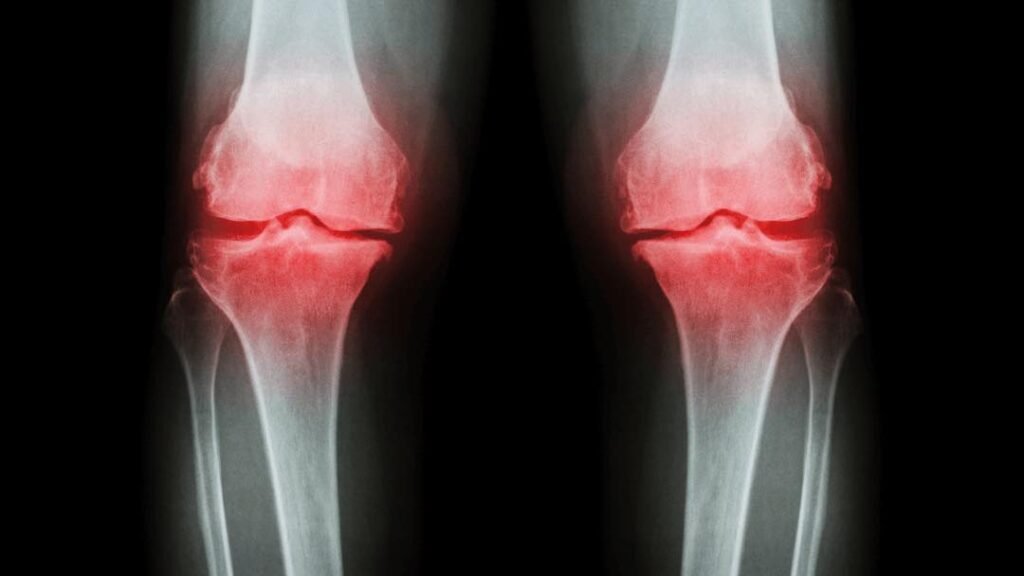
When people hear the words knee osteoarthritis, the first thoughts are usually:
👉 Don’t use it
👉 Don’t walk too much
👉 Don’t exercise
👉 You’ll wear it out faster
This belief is actually one of the main reasons knees deteriorate more quickly — without people realizing it.
Today, let’s shift the perspective.
Not based on fear.
Not based on feelings.
But based on real biological mechanisms.
Osteoarthritis ❌ is not as simple as:
“Use it a lot → it wears out.”
It’s much more complex than that.
⸻
🧩 So Where Does Knee Osteoarthritis Really Come From?
Knee osteoarthritis does not arise from a single cause.
It is a whole-joint disease.
Multiple factors accelerate the degenerative cycle:
▪️ Excess body weight
Extra fat mass continuously increases mechanical load on the joint.
▪️ Insulin resistance (from overeating + inactivity)
Chronically elevated blood sugar → low-grade inflammation → real damage to cartilage.
▪️ Weak thigh and hip muscles
When the muscular chain is not strong enough to stabilize the joint, the load hits the cartilage directly — accelerating degeneration.
▪️ Prolonged inactivity
Joints that don’t move lose resilience.
▪️ Genetics
Yes, genetics matter. But they’re not modifiable.
All of these contribute to:
✔️ Cartilage thinning and breakdown
✔️ Poor load distribution → narrowing joint space
✔️ Cartilage cells activating “self-destruct mode” (apoptosis)
✔️ Chronic low-grade inflammation inside the joint
✔️ Muscle weakness → repeated direct impact on the joint surface
In simple terms:
👉 Knees don’t deteriorate because they are used.
👉 They deteriorate because they are used without balance — and without muscular support.
⸻
🏃♀️ Why Exercise Actually Helps Knee Osteoarthritis
Appropriate exercise is not the enemy of your knees.
It is a repair signal.
Here’s what truly happens biologically:
✔️ Proper mechanical loading
→ Cartilage cells have mechanosensors.
→ The right amount of compression helps them survive.
→ It reduces apoptosis.
✔️ Stronger muscles around the joint (this is critical)
→ Muscles absorb force before it reaches the cartilage.
→ They stabilize the upper leg and pelvis.
→ They reduce direct joint stress.
✔️ Reduction of inflammatory mediators
Exercise increases anti-inflammatory signaling (such as IL-6 in its exercise context) and reduces pro-inflammatory fat-derived signals.
→ Breaks the pain–swelling–degeneration cycle.
✔️ Joint movement
→ Distributes synovial fluid
→ Nourishes cartilage
→ Improves tissue survival
The results:
👉 Less pain (especially with consistency)
👉 Improved walking pattern — avoiding persistent antalgic gait
👉 Slower structural progression
Most importantly, combining exercise with dietary control reduces excess fat mass — directly lowering load on the knee joint.
For people with obesity, weight loss can dramatically improve symptoms.
⸻
⚠️ What Kind of Exercise Is Good — And What Should Be Avoided?
(For people who already have osteoarthritis)
1️⃣ Low-Impact Aerobic Exercise
✔️ Walking on flat ground
✔️ Cycling
✔️ Swimming or water walking
These improve circulation and metabolic health without excessive joint stress.
2️⃣ Strength Training for Knee and Hip Muscles
(This is the heart of treatment.)
Key muscle groups:
▪️ Quadriceps
▪️ Hamstrings
▪️ Hip muscles (especially gluteals)
Examples:
✔️ Sit-to-stand from a chair
✔️ Shallow squats
✔️ Low step-ups
✔️ Hip strengthening exercises
Very important principle:
👉 Strong muscles = Protected joints
Proper technique matters greatly.
Incorrect form can create unnecessary shear forces.
3️⃣ Mobility & Range-of-Motion (ROM) Work
✔️ Reduces stiffness
✔️ Reduces fear of movement
✔️ Maintains long-term joint usability
⚠️ Exercises to Avoid During Active Pain or Instability:
❌ Jumping
❌ Deep squats
❌ Rapid twisting with planted feet
These increase compressive and shear forces on the joint.
⸻
🟢 For Those Who Don’t Have Osteoarthritis Yet
There are no strict restrictions.
Because osteoarthritis is multi-factorial, prevention is broad.
Any form of exercise is beneficial — especially strengthening the leg muscles.
One key rule:
✔️ Proper alignment and anatomy matter.
Incorrect biomechanics — especially in strength training — create risk.
Follow credible experts.
Learn proper technique.
⸻
🧠 Summary
Knee osteoarthritis is influenced by many factors.
❌ It is not a disease that requires stopping movement.
❌ It is not solved by rest alone.
It is a condition that requires:
✔️ Proper use of the knee
✔️ Strong muscular support
✔️ Consistent, moderate exercise
The better you move:
👉 The less pain you feel
👉 The longer you walk
👉 The slower degeneration progresses
⸻
Being able to walk independently
is a freedom most people only value
when it begins to disappear.
Knee osteoarthritis is not a command to stop living.
In fact — the more you freeze,
the harder it is to move again later.
Move wisely.
Strengthen intentionally.
Use your knees correctly.
And if you’re not affected yet —
start exercising today.
After your aerobic fitness improves,
don’t forget to build strength too.


Leave a Reply