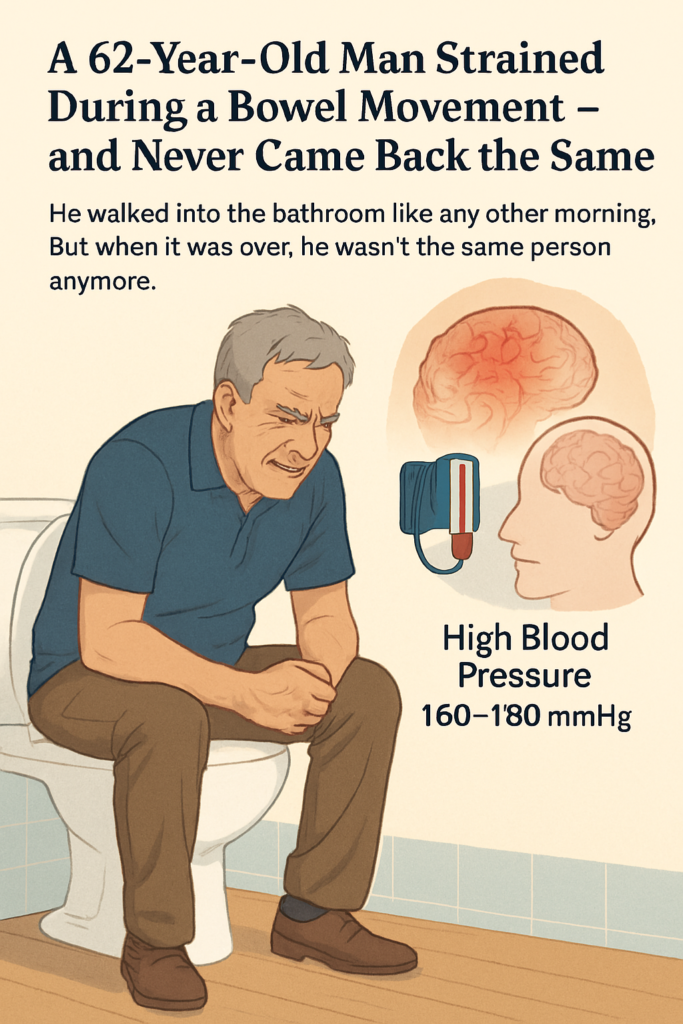
A 62-Year-Old Man Strained During a Bowel Movement — and Never Came Back the Same
“He walked into the bathroom like any other morning. But when it was over, he wasn’t the same person anymore.”
A 62-year-old man had lived with high blood pressure for decades — and managed it poorly. For years, his systolic pressure hovered around 160–180 mmHg. He kept his clinic appointments inconsistently, and even when he had his medication, he rarely took it. On days he felt dizzy, he’d assume his blood pressure was high and take a pill then. So in reality, he was barely medicating at all.
Time passed quickly. Seeing those numbers at check-ups, he started to think it was just his “normal.” He only took his medication when something felt off. For the past month, he’d been dealing with constipation, spending long stretches in the bathroom. His wife had wanted to take him for a colonoscopy and back to the doctor for his blood pressure. He refused.
On the morning of the incident, he walked into the bathroom as usual. But his wife noticed he was straining harder than normal — several times in a row. Then silence. She heard what sounded like something hitting the bathroom floor, and rushed in to find him lying on his side, unresponsive to his name, with a drooping face.
She called an ambulance immediately.
At the emergency room, doctors quickly assessed him and suspected a stroke. A brain CT scan was ordered right away.
The results showed a hemorrhage deep in the brain, in a region called the Thalamus, with blood breaking through into the ventricles (fluid-filled chambers of the brain).
The Thalamus is one of the most common sites for hypertensive brain bleeds — second only to the Basal ganglia — because the blood vessels there are subjected to the highest shear forces. When blood pressure remains elevated over a lifetime, it slowly damages vessel walls, breaking down the structural fibers and smooth muscle that keep them strong.
Eventually, the vessel wall bulges outward into a tiny pocket called a Charcot-Bouchard aneurysm — sitting silently, waiting for the moment when blood pressure suddenly spikes to tear it open.
In this patient’s case, the constipation and repeated straining were the trigger. The Valsalva maneuver — the act of bearing down with a held breath — causes a sharp pressure surge the moment the strain is released. His blood pressure was already high to begin with. That surge pushed it even higher, rupturing the pre-existing aneurysm. Blood flooded the Thalamus, and the resulting clot compressed the internal capsule — the nerve fiber tract controlling movement — causing sudden weakness on one side of his body.
Key Takeaways from This Case
1️⃣ High blood pressure is terrifying precisely because it’s silent. It quietly erodes your blood vessels, little by little. By the time complications appear, significant damage has already been done. Managing it requires serious lifestyle changes — and if those aren’t enough to bring it down, medication is necessary. Once everything is under control, a doctor can gradually reduce and eventually stop the medication.
2️⃣ If you have constipation, address it seriously:
- Eat vegetables and low-sugar fruits rich in dietary fiber
- Drink enough water to reduce excessive ADH-driven water reabsorption, keeping stools from hardening
- Exercise regularly
- If constipation is severe, see a doctor to find the cause and use appropriate laxatives
3️⃣ Recognize the warning signs of a stroke — act immediately:
- Sudden, unusually severe headache
- Dizziness, sudden weakness in the arms or legs
- Slurred speech or facial drooping
- Any sudden abnormal symptom
Call for help / dial emergency services right away. Do not wait.


Leave a Reply