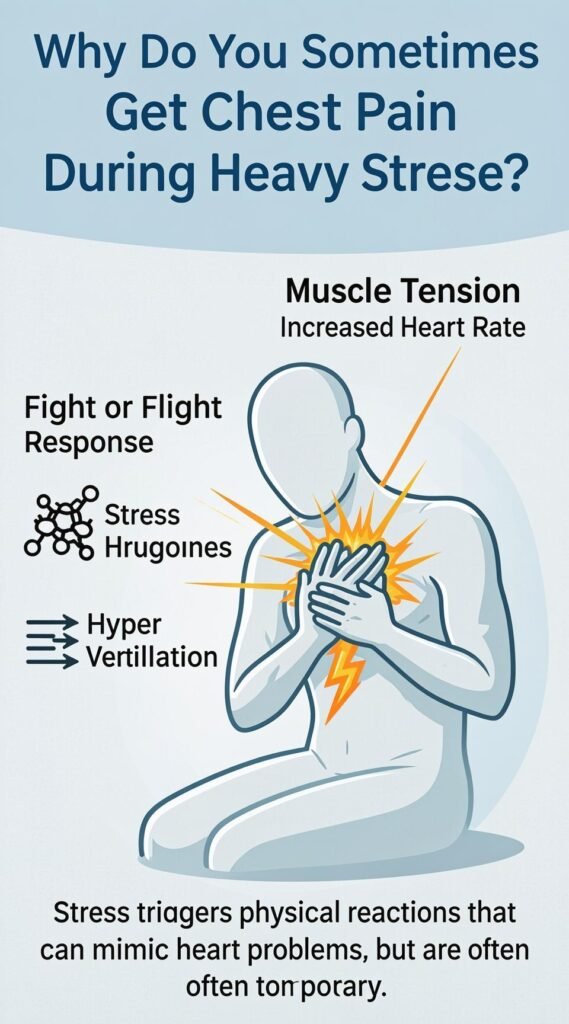
Why Do You Sometimes Get Chest Pain During Heavy Stress?
We believe everyone has experienced this at some point. It tends to happen during the rougher patches of life. For those with depression, anxiety, or panic disorder, it can occur even more frequently. And sometimes it messes with your head — is this a heart problem?
The answer is this: the mind arises from how the brain works, and the brain is connected to the internal organs in both directions — both sending signals (Autonomic nervous system) and receiving them (Visceral sensation). So it’s no surprise that psychological stress can produce very real physical symptoms — not made up at all. (Though some people do like to assume others are faking it, don’t they.)
When stress occurs, the body automatically activates its fight-or-flight mode through the sympathetic nervous system and the hormones adrenaline and cortisol.
The effects of sympathetic activation and adrenaline can:
- Cause the blood vessels supplying the muscles and structures of the chest to constrict (vasoconstriction), reducing blood flow to the area
- Make those muscles more sensitive to stimulation (Gamma-motor neuron sensitization), increasing the chance of spasm when triggered
So there’s a real possibility of chest muscles going into spasm, poor circulation, and acid buildup — all of which can stimulate pain. It’s not dangerous, and in most cases doesn’t amount to much discomfort on its own.
Because one hand clapping rarely makes a sound.
The other side of the equation — the nervous system that receives pain — usually has its own issues too.
Stress, especially severe or chronic stress, causes cortisol and adrenaline to alter multiple regions of the brain.
For example, the dlPFC (a region involved in emotional regulation) becomes less active, allowing the amygdala — which processes negative emotions including fear and pain — to become overactive.
On top of that, the body’s natural pain-suppression system, the PAG-descending pathway, is dialed down.
This means that if any pain mechanism gets triggered, you’ll feel it more intensely than usual — because the pain signal is being amplified, and it hits the emotional centers harder.
And if you also have anxiety, panic disorder, or depression, the anterior insula — the part of the brain that monitors signals from internal organs — can become especially “attentive” to those signals, making the pain feel even more prominent.
To put it simply: stress causes muscle tension and reduced blood flow, while the nervous system becomes more sensitive to pain signals, and the brain pays more attention to them than it normally would.
If there’s an underlying psychiatric condition, or sleep deprivation on top of that, these symptoms tend to become more frequent.
All of this together is how chest pain can arise — without any direct disease of the internal organs. The pain typically has these characteristics:
✔️ Location is inconsistent, shifting around ✔️ Character varies widely — sharp, tight, burning, dull ✔️ Duration is irregular — sometimes a few seconds, sometimes a dull ache for hours ✔️ Not related to exertion — can appear randomly, regardless of activity ✔️ Often occurs during stress or overthinking
That said, chest pain can range from something trivial to something life-threatening. If you’re unsure, or if it doesn’t feel like just a passing twinge, please go to the hospital — especially if you have:
⚠️ A heavy, pressing, squeezing, or crushing sensation in the center of the chest (not a sharp stab)
⚠️ Pain radiating to the left arm, neck, jaw, or back (especially if it feels deep or runs along a line)
⚠️ Pain that comes on with exertion and improves with rest (Exertional chest pain)
⚠️ Pain that lasts more than 10–15 minutes, or keeps recurring but getting more frequent and severe
⚠️ Associated symptoms such as breathlessness, sweating, palpitations, nausea, or dizziness
⚠️ Pain that comes on at rest with no clear cause, especially if it’s never happened before
⚠️ Pain in someone with risk factors — diabetes, high blood pressure, high cholesterol, smoking, or age over 40
⚠️ Pain that feels different from before — stronger, longer, or just somehow off
⚠️ Pain that just feels seriously wrong
Chest pain from psychological causes is not dangerous, and it can go away — if you take care of your mental health and bring it back to a healthier place.
Wishing everyone strength 💙


Leave a Reply