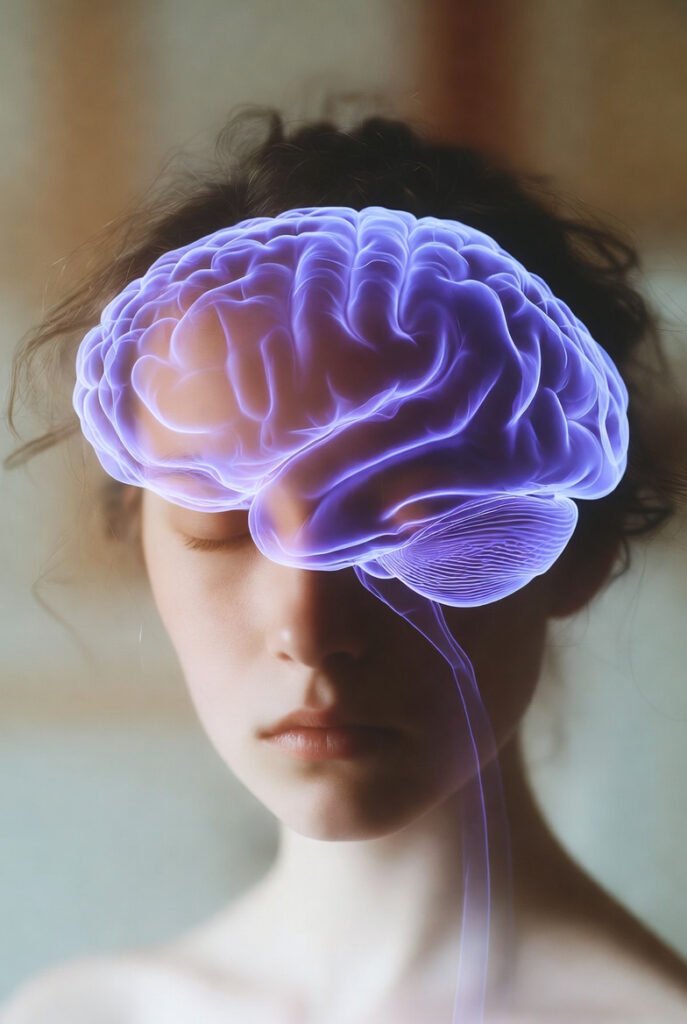
Have you ever planned to meet a friend or start a project, only to feel an overwhelming, heavy resistance pulling you back into the shadows? It isn’t a lack of willpower or “laziness”; it is a sophisticated neurological “kill switch” deep within your brain deciding your limits for you. This invisible barrier is driven by a specific survival circuit that, in the context of depression, transforms from a protective shield into an inescapable cage.
The “Antireward System” is Your Internal Brake
While we often discuss the brain’s “reward system” that drives us toward goals, we rarely examine its shadow: the Lateral habenula (LHb), also known as the “antireward system.” Think of the LHb as the brain’s ultimate curtain closer. When the brain evaluates a potential action and deems it “not worth it” or “potentially painful,” the LHb acts as an internal brake to stop you in your tracks.
The mechanism is a masterful display of dopaminergic suppression. When triggered, the LHb sends direct signals to inhibit the Ventral Tegmental Area (VTA)—the engine of desire and the primary source of dopamine. To ensure the message is absolute, the LHb also recruits the RMTg (rostral medial tegmental nucleus), which acts as a secondary layer of suppression, “double-locking” the VTA. This effectively kills the engine of motivation before you even move a muscle. As the neurological evidence suggests, the LHb broadcasts a visceral warning: “Don’t go, it’ll hurt, it’ll be disappointing, it’ll be a trigger.”
The “Double Whammy” of the Depressed Brain
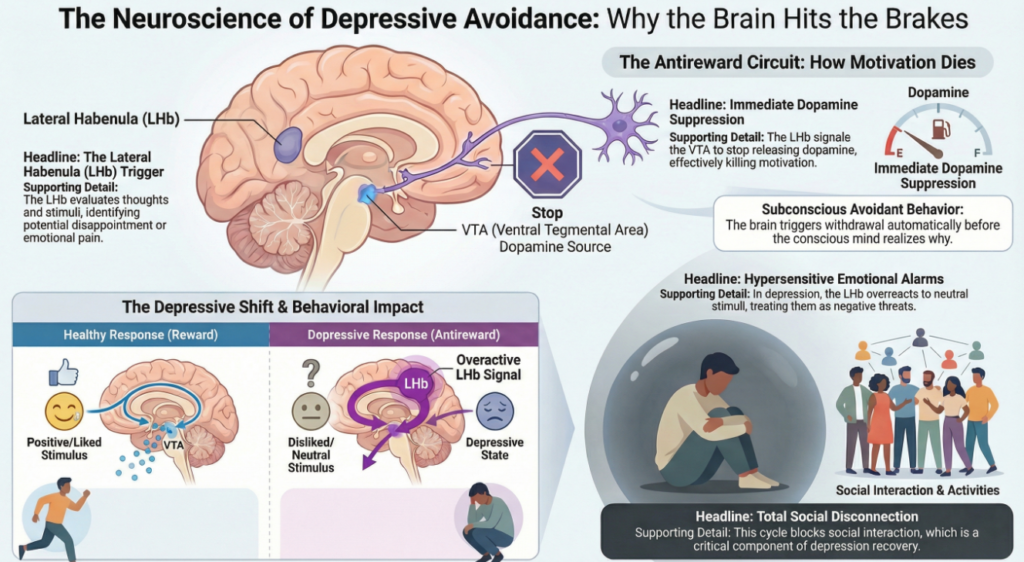
In a healthy state, the reward and antireward systems maintain a delicate equilibrium. However, in a depressed brain, this balance suffers a devastating two-fold malfunction that breaks the machinery of motivation:
1. A Stalled Reward System: This results in anhedonia, a state where the “gas pedal” of the brain is broken. Even facing things you once loved, the VTA fails to spark, and the Nucleus Accumbens (NAcc)—the brain’s pleasure center—remains silent.
2. A Hyperactive Antireward System: Simultaneously, the LHb becomes dangerously hypersensitive. Crucially, it begins to fire intensely not just for negative stimuli, but even for neutral or average stimuli.
This is the “double whammy”: your brain is unable to feel the “pull” of a reward while being aggressively “pushed” away by an overactive alarm. In this state, a simple text or a minor chore is miscategorized as a high-risk threat, leading to “extreme lows” (ดิ่งมาก) and, in severe cases, the dark neurological pathways associated with self-harm.
Avoidance as an Unconscious (but Extreme) Shield
This internal conflict manifests outwardly as “Avoidant Behavior.” One of the most exhausting aspects of this condition is that it occurs unconsciously. The brain “tags” activities as negative with a biological watermark before your conscious mind can even process the situation.
From an evolutionary perspective, this is a protection mechanism designed to shield you from pain or failure. In depression, however, this shield becomes extreme and maladaptive. The brain decides to stop exploring the world entirely to prevent any possibility of a negative outcome, choosing to shut down vital functions rather than risk a “trigger.”
The Social Vanishing Act: A Biological Paradox
This internal “tagging” of threats manifests most visibly in how we navigate our relationships, though the presentation differs based on personality:
• Extroverts: For those typically fueled by social interaction, the change is jarring. They may suddenly and completely vanish from their circles, as their hyperactive LHb overrides their natural drive to connect.
• Introverts: Since social interaction already taxes an introvert’s energy, the antireward system often pushes them toward a near 100% withdrawal from the world.
This leads to a tragic Biological Paradox: the overactive LHb forces the individual to avoid Social Intervention—the very human connection that the brain requires to recalibrate its reward system and facilitate recovery. By “protecting” the individual from the perceived stress of others, the brain inadvertently blocks the most effective path to healing.
Conclusion: Breaking the Circuit
When the brain’s antireward system takes over, it isn’t a matter of “snapping out of it.” The brain is physically suppressing the neurochemistry required for engagement and joy. Because this system is linked to profound isolation and the risk of extreme clinical lows, seeking professional help is a medical necessity rather than a personal choice.
Understanding the biology of avoidance shifts the narrative from one of “shame” to one of “physiology.” If we recognize that the brain is simply overreaching in a desperate attempt to protect itself, we can replace judgment with compassion—viewing treatment not as a sign of weakness, but as a vital reboot for a system that has forgotten how to let the light in.


Leave a Reply